- 01
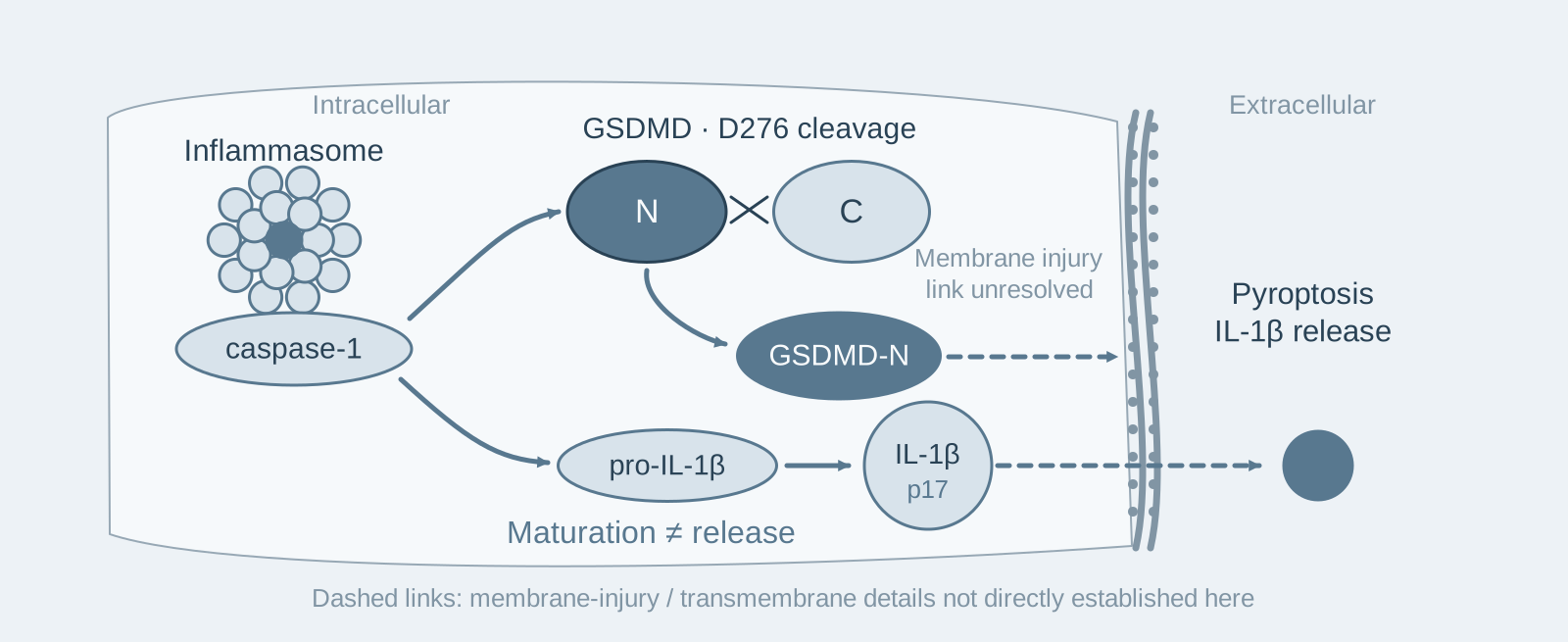
Main finding: GSDMD knockout eliminates pyroptosis and IL-1β release, while caspase-1 activation and IL-1β maturation continue as usual;
- 02
Key mechanism: Caspase-1 cleaves GSDMD at D276, relieving C-terminal autoinhibition and releasing a cytotoxic N-terminal fragment;
- 03
Significance: The study separates IL-1β "maturation" and "release" into two independent steps and establishes a research direction in which the gasdermin family executes programmed necrosis.
On this page
1. What question does this paper answer?
Why do cells swell, burst, and die (pyroptosis) after an inflammasome activates caspase-1? Before 2015, none of the known caspase-1 substrates could explain this, and the identity of the pyroptosis executor was the field's largest gap. Another related question had long been conflated with it: when IL-1β cannot be detected in the supernatant, has it failed to be cleaved and mature, or has it matured but cannot be released? This paper answers both questions through a single chain of evidence.
2. Following the logic of the evidence
Step 1: Screening candidate proteins (Figure 1). The authors activated inflammasomes in macrophages and used time-resolved mass spectrometry to identify proteins that became progressively enriched during activation. They then combined this with CRISPR screening to knock out the 9 candidates one by one, finding that only GSDMD knockout could simultaneously block pyroptosis and IL-1β in the supernatant. One detail in the reconstitution experiments deserves attention: reintroducing C-terminally tagged GSDMD into the knockout cells restored function, whereas reintroducing N-terminally tagged GSDMD did not. These results indicate that the N terminus of GSDMD is its functional module, a conclusion that was later directly confirmed.
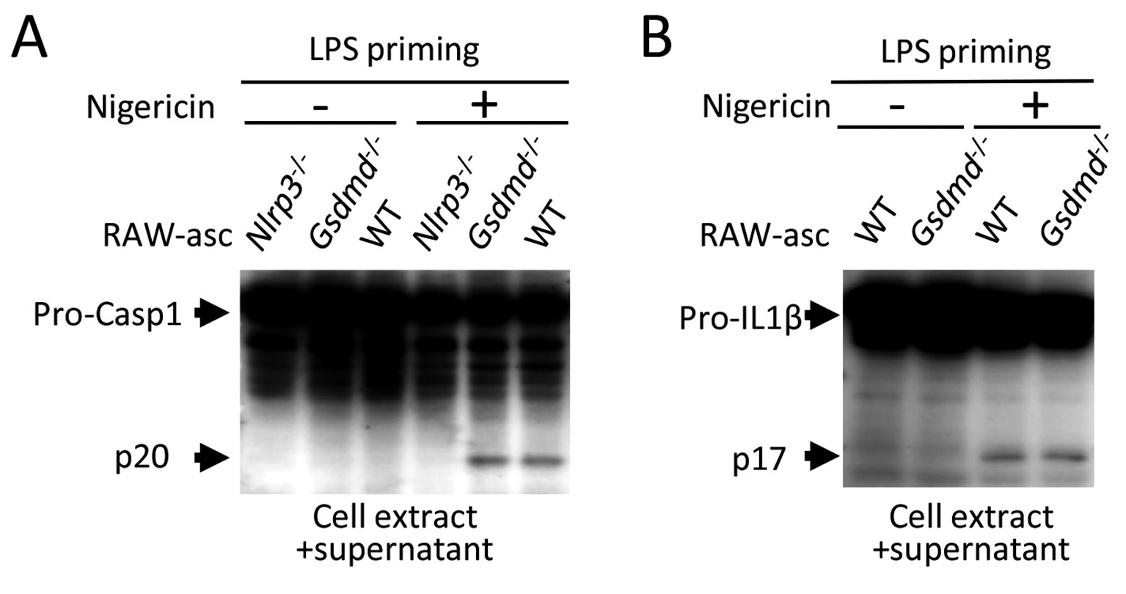
Step 2: Distinguishing "maturation" from "release" (Figure 2). This is the conceptual core of the paper. The authors activated inflammasomes in Gsdmd-knockout macrophages and examined cell lysates and supernatants. In the lysates, caspase-1 was still cleaved to p20 and pro-IL-1β was still cleaved to p17, while almost no IL-1β could be detected in the supernatant. These results show that GSDMD does not participate in IL-1β maturation; it determines only whether mature IL-1β can be released outside the cell.
Step 3: Testing the relationship between cleavage and function (Figures 3–4). The authors reintroduced D276-site mutant GSDMD into knockout cells and found that a protein that could not be cleaved could not restore pyroptosis. Expressing the N-terminal fragment alone was sufficient to kill cells, whereas the full-length protein and the C-terminal fragment were not. These results indicate that cleavage is a necessary step for GSDMD to acquire cytotoxicity. The authors then used caspase-1 mutants to examine the conditions required for cleavage. A caspase-1 mutant defective in self-cleavage but retaining enzymatic activity could still cleave GSDMD and kill cells, whereas an enzymatically inactive mutant could not. This indicates that pro-caspase-1 can cleave GSDMD without ASC and without completing its own processing. Cleaving pro-IL-1β, however, requires more fully activated caspase-1. The two substrates differ in the degree of enzyme activation they require.
Step 4: How do cells die when pyroptosis is blocked? (Figure 5). After activating inflammasomes in Gsdmd-knockout cells, the authors found that the cells did not survive but instead switched to apoptosis: caspase-8, -3, and -7 were activated. The LDH release that appeared later arose from secondary necrosis after apoptosis, rather than residual pyroptosis.
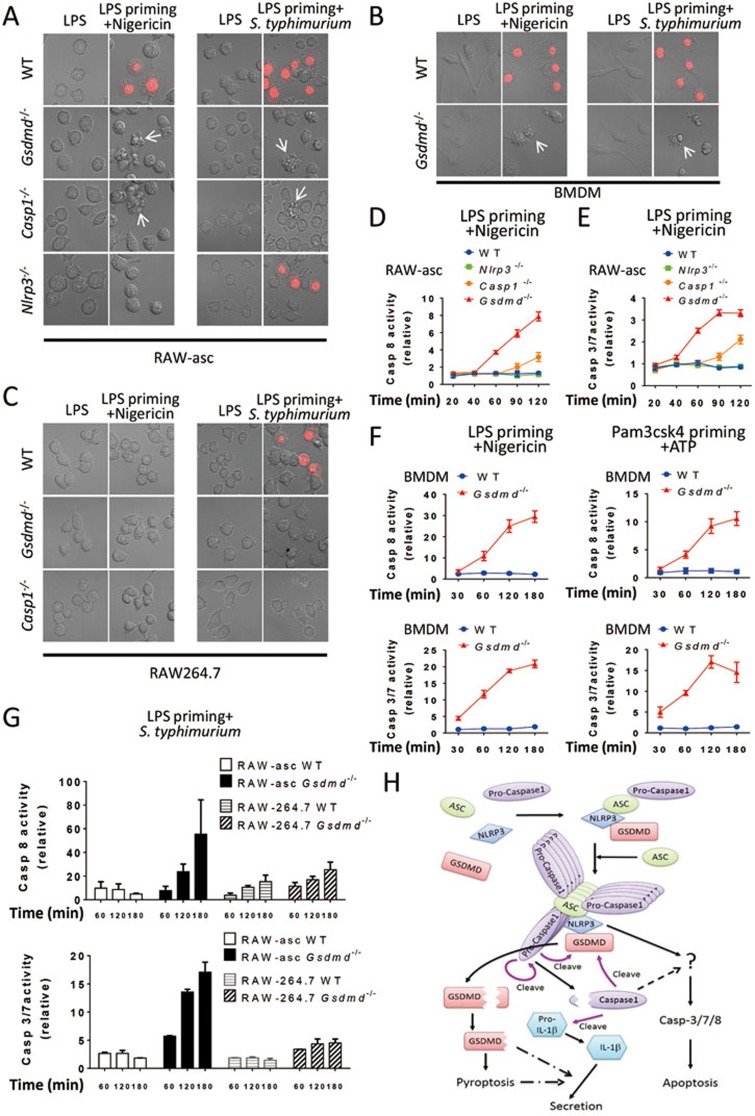
Conclusion: Caspase-1 cleaves GSDMD and releases its N-terminal killing fragment. GSDMD executes pyroptosis and determines whether mature IL-1β can leave the cell; when pyroptosis is blocked, the inflammasome instead induces apoptosis.
3. Implications for experiments
- Measure "maturation" and "release" separately: Examining both cell lysates and supernatants is necessary to distinguish "not cleaved" from "cleaved but unable to be released". ELISA of the supernatant alone cannot distinguish these two situations.
- Tag position itself provides functional information: In this paper, an N-terminal tag did not affect cleavage but disrupted function. When constructing fusion proteins, both N- and C-terminal tags should be tested, particularly for proteins whose functions are unknown.
- LDH is not a specific marker of pyroptosis: Late LDH release can arise from secondary necrosis after apoptosis. To determine the mode of cell death, consider the time course, morphology, caspase activity, and substrate cleavage together.
4. Connections to other papers on this site
- Extension | Caspase-1 initiates apoptosis through Bid (Tsuchiya 2019, Nat Commun): Step 4 of this paper observed that Gsdmd-knockout cells switch to apoptosis. The Tsuchiya paper explains the mechanism: caspase-1 cleaves Bid at D59 and activates caspase-3 through the mitochondrial pathway.
- Comparison | BAX/BAK mitochondrial apoptosis activates IL-1β (Vince 2018, Cell Rep): This paper establishes caspase-1–GSDMD as the core pyroptosis axis. The Vince paper finds that GSDMD is cleaved during BAX/BAK apoptosis but is not required. The difference arises from the different cell-death contexts: "GSDMD is an executor of pyroptosis" cannot be extrapolated to "all IL-1β release depends on GSDMD".
- Extension | GSDME mediates secondary necrosis after apoptosis (Rogers 2017, Nat Commun): In this paper, "inflammatory caspases cleave GSDMD to execute pyroptosis"; in the Rogers paper, "apoptotic caspase-3 cleaves GSDME to execute secondary necrosis". The same architecture of "N-terminal killing and C-terminal autoinhibition" serves two cell-death pathways.
- Comparison | TNF-α + IFN-γ synergistic PANoptosis (Karki 2021, Cell): In that paper, GSDMD does not execute pyroptosis; instead, caspase-3/7 cleaves it into an inactive P20 fragment, while GSDME is responsible for pore formation. The difference arises from the upstream caspases, rather than conflicting conclusions.
(The comparisons across papers above are a synthesis, rather than a direct conclusion of any one original paper.)
What remains unresolved
Limitations (two points): ① This paper does not directly establish how the GSDMD N terminus disrupts the plasma membrane, including whether it forms pores; the authors explicitly state that this remains to be tested. ② The mechanism by which pyroptosis suppresses apoptosis remains unexplained, and its significance in vivo was not systematically tested.
Gasdermin D is an executor of pyroptosis and required for interleukin-1β secretion
He, Wan-ting; Wan, Haoqiang; Hu, Lichen; Chen, Pengda; Wang, Xin; Huang, Zhe; Yang, Zhang-Hua; Zhong, Chuan-Qi; Han, Jiahuai Cell Research. 2015;25:1285-1298.
Figures are from the verified original paper stored in the library. Original labels, axes and controls are retained; figure numbers and sources are registered in the library.
References
- He WT, Wan H, Hu L, Chen P, Wang X, Huang Z, Yang ZH, Zhong CQ, Han J. Gasdermin D is an executor of pyroptosis and required for interleukin-1β secretion. Cell Research. 2015;25(12):1285-1298. doi:10.1038/cr.2015.139
- Kayagaki N, Stowe IB, Lee BL, et al. Caspase-11 cleaves gasdermin D for non-canonical inflammasome signalling. Nature. 2015;526(7575):666-671.
- Shi J, Zhao Y, Wang K, et al. Cleavage of GSDMD by inflammatory caspases determines pyroptotic cell death. Nature. 2015;526(7575):660-665.
Paper discussion
No sign-up. Nickname optional.