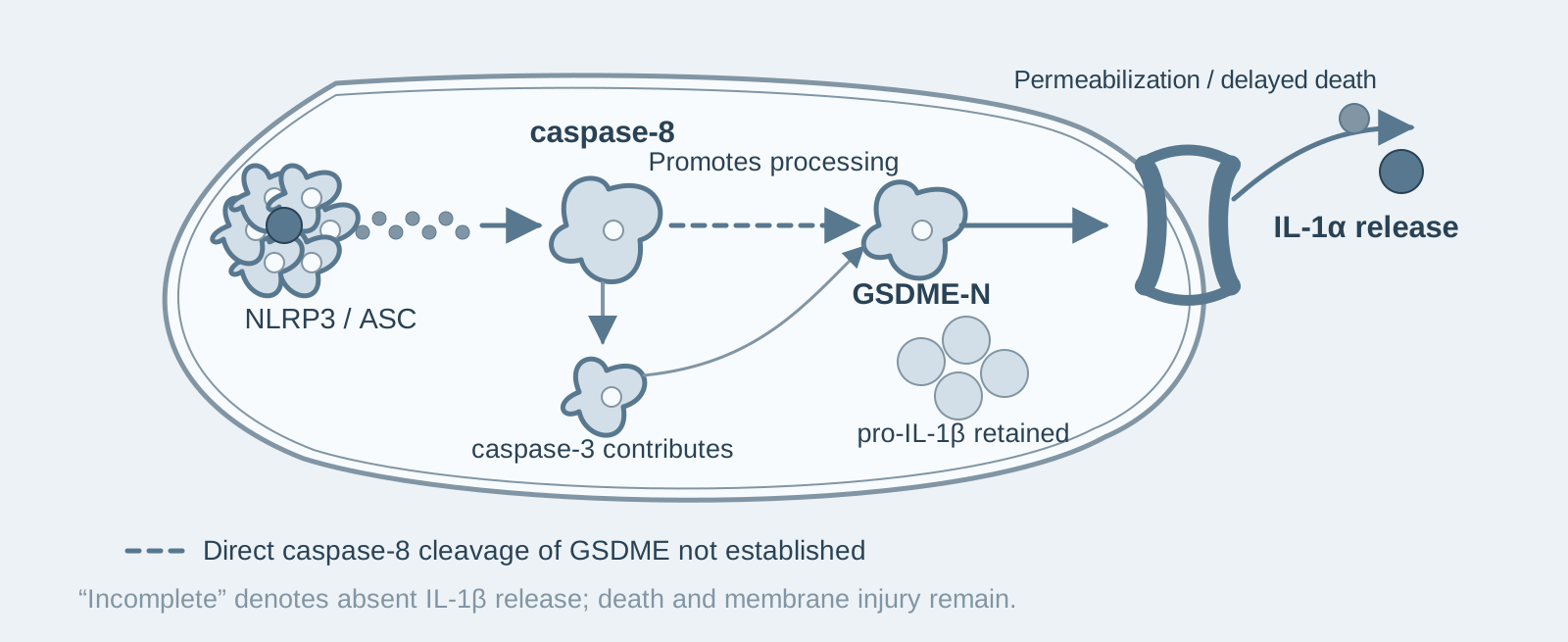
- 01
The NLRP3 inflammasome can still induce necrotic cell death in the absence of caspase-1/11;
- 02
ASC initiates GSDME-dependent pyroptosis through caspase-8;
- 03
This form of death releases IL-1α but not IL-1β; pharmacological inhibition of caspase-1 with VX-765 likewise permits IL-1α release.
On this page
1. What question does this paper answer?
Caspase-1 inhibitors such as VX-765 are candidate drugs for inflammatory diseases, but how cell death and IL-1 family cytokines change after caspase-1 inhibition remains unclear. Using macrophages from caspase-1/11 double-knockout mice and CASP1-knockout THP-1 cells, this study demonstrates that, after NLRP3 inflammasome activation, ASC instead activates caspase-8, and caspase-8 processes GSDME to execute a delayed form of pyroptosis. Its defining features are the absence of IL-1β release, with pro-IL-1β retained inside dying cells, and the preservation of IL-1α release. The authors call this "incomplete pyroptosis".
2. The logic of the evidence
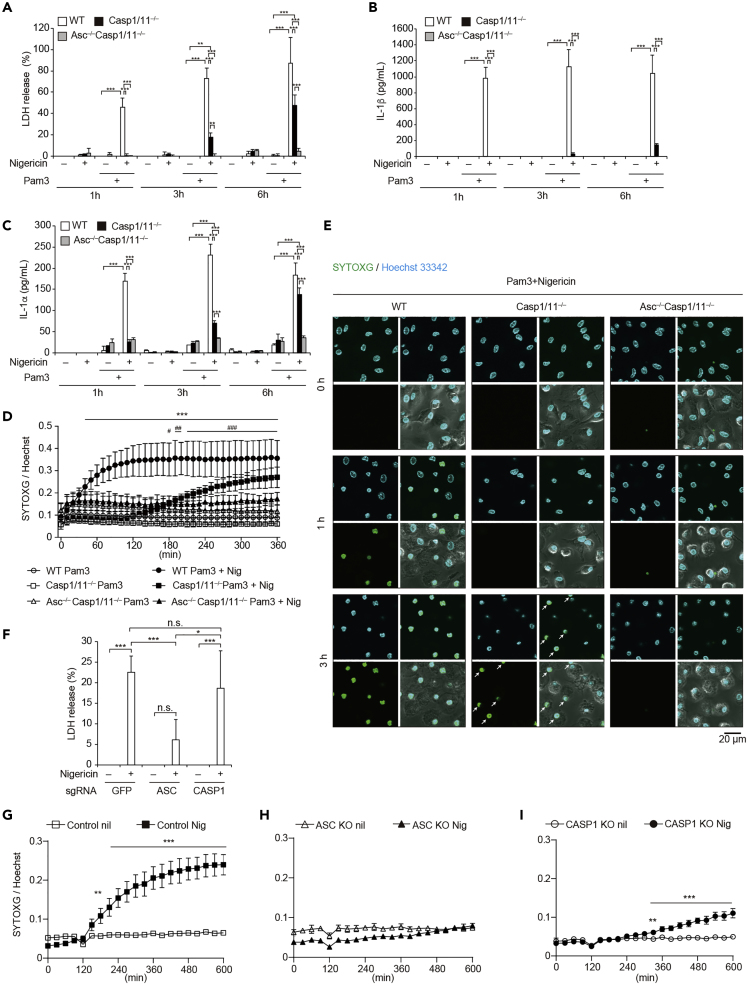
Step 1: Without caspase-1/11, NLRP3 activation still induces delayed death through ASC, selectively permitting IL-1α release (Figures 1–2). The authors primed peritoneal macrophages with Pam3CSK4 and then stimulated them with nigericin, a potassium ionophore and a classic NLRP3 activator. Wild-type cells began to die at 40 minutes, whereas Casp1/11 double-knockout cells did not begin to die until 180 minutes. Additional ASC knockout in the double-knockout background abolished this delayed death. IL-1β was entirely undetectable in the supernatant, yet substantial amounts of IL-1α were released. To exclude nonspecific nigericin toxicity, the authors instead used THP-1 cells with doxycycline-inducible expression of the NLRP3 D303N mutant, a constitutively active mutation identified in patients with CAPS. CASP1-knockout cells showed the same delayed death, whereas ASC knockout completely prevented it. These results show that in the absence of caspase-1/11, the NLRP3 inflammasome can still induce delayed necrotic death through ASC and selectively permit IL-1α release.
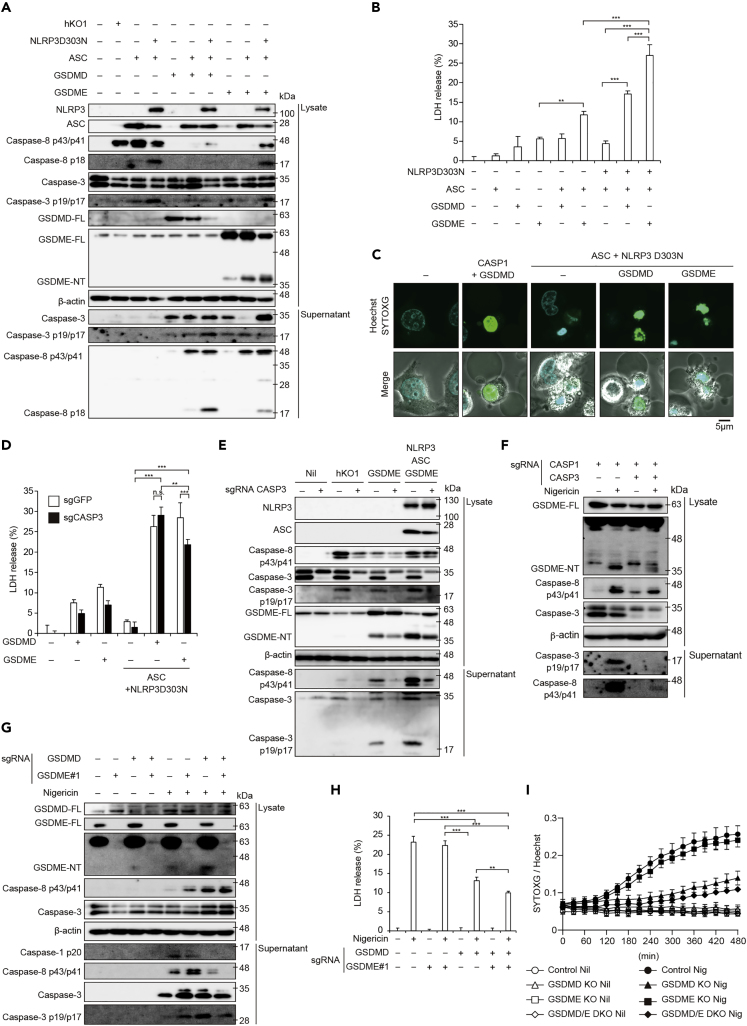
Step 2: The executor is GSDME processed by caspase-8, while caspase-3 serves only as an amplifier (Figures 3–6). The pan-caspase inhibitor Z-VAD blocked this death; at later time points, however, death switched to RIPK3–MLKL-dependent necroptosis, which was further inhibited by combining Z-VAD with the RIPK3 inhibitor GSK′872. Immunoblotting showed activation of caspase-8 and caspase-3 and processing of GSDME in the double-knockout cells, whereas no active GSDMD fragment was detected. Triton X-114 phase separation confirmed that the membrane fraction contained the N-terminal fragment of GSDME rather than GSDMD. The caspase-8 inhibitor IETD inhibited death and GSDME processing more strongly than the caspase-3 inhibitor DEVD. Death and GSDME processing were both reduced in CASP1/CASP8 double-knockout THP-1 cells, whereas CASP3 knockout caused only a partial reduction, and GSDME processing persisted in CASP1/CASP3 double-knockout cells. In HeLa reconstitution experiments, ASC-activated caspase-8 also preferentially processed GSDME rather than GSDMD. These results show that ASC-activated caspase-8 acts as the initiator that processes GSDME, with GSDME responsible for executing pyroptosis; caspase-3 contributes but is not essential.
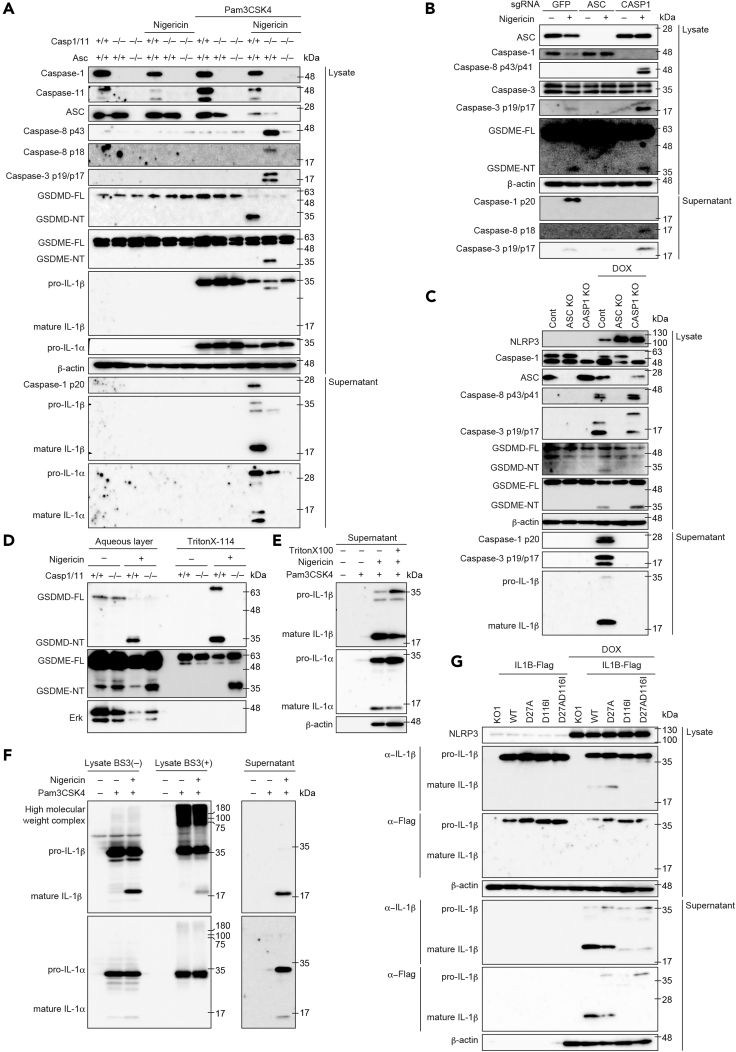
Step 3: Pro-IL-1β is retained inside pyroptotic cells, and cleavage is a prerequisite for release (Figure 4). Despite prominent caspase-8 activation in the double-knockout cells, almost no mature IL-1β (p17) was produced; only a partially processed 28 kDa product was detected. When already pyroptotic wild-type cells were lysed with Triton X-100, pro-IL-1β in the supernatant increased markedly, while mature IL-1β remained unchanged. BS3 cross-linking showed that IL-1β existed in high-molecular-weight complexes, whereas IL-1α was predominantly monomeric. After IL-1β cleavage-site mutants (D116I and D27A/D116I) were introduced into cells, the mutants were no longer cleaved and were barely released; they were detected only after lysis. These results show that pro-IL-1β is retained in molecular complexes inside pyroptotic cells, and caspase-mediated cleavage is necessary for its efficient release.
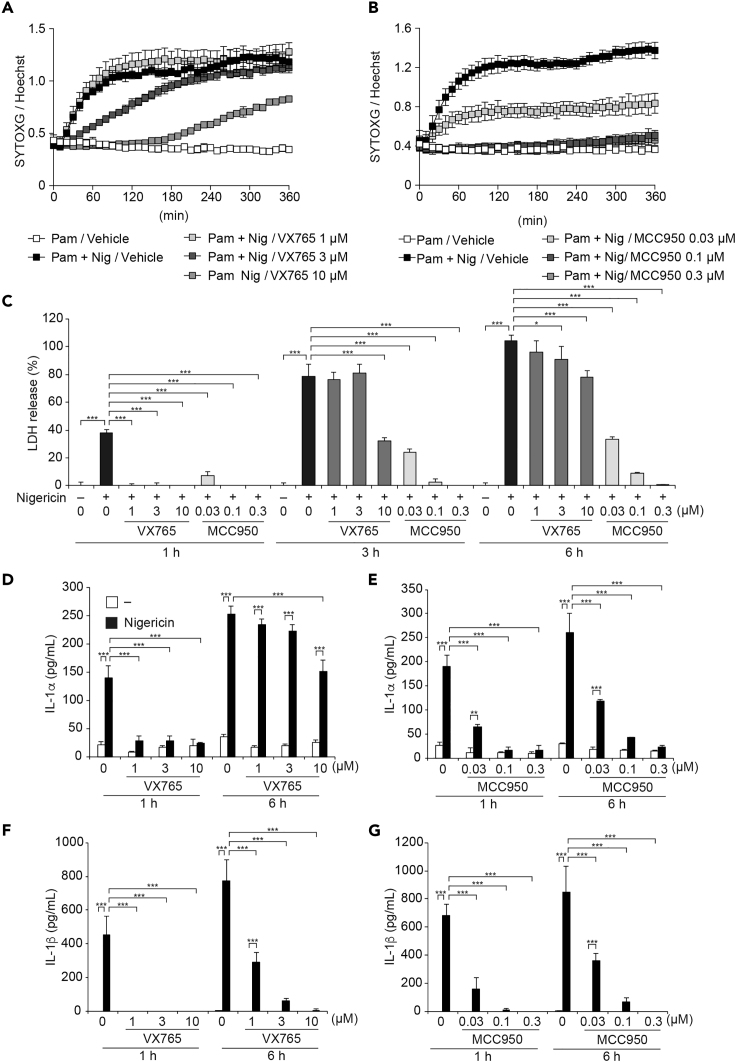
Step 4: Pharmacological inhibition reproduces the same phenotype—VX-765 does not prevent death or IL-1α release (Figure 7). In wild-type macrophages, the caspase-1 inhibitor VX-765 only delayed death. LDH, or lactate dehydrogenase, a marker of membrane rupture, was still released after 3–6 hours, and substantial IL-1α was detected, while IL-1β was inhibited. This was accompanied by reduced GSDMD processing and increased GSDME processing. The NLRP3 inhibitor MCC950, by contrast, blocked death and the release of both IL-1 cytokines. These results show that caspase-1 inhibition dissociates cell death and IL-1α release from IL-1β release; clinically, inhibiting caspase-1 does not equate to inhibiting inflammatory cell death.
3. Implications for experiments
- When evaluating the effects of VX-765, a positive LDH readout does not mean the experiment has failed: death is merely delayed and executed instead by GSDME. IL-1β is the readout that reflects caspase-1 inhibition itself; complete blockade requires an upstream NLRP3 inhibitor such as MCC950.
- Seeing an N-terminal GSDME band in caspase-1-knockout cells indicates that the ASC–caspase-8 bypass is operating: cells with low caspase-1 expression and high caspase-8 expression are more likely to use this bypass. GSDME expression can also determine whether the form of death tends toward apoptosis or pyroptosis.
- An IL-1β-negative supernatant does not mean the IL-1 family is silent: IL-1α is still released, while pro-IL-1β remains intracellular. Measuring only the supernatant misses both aspects; a lysate control and concurrent IL-1α measurement are needed.
4. Connections to other papers on this site
- Comparison | Bidirectional crosstalk between pyroptosis and apoptosis (Taabazuing 2017, Cell Chem Biol): Taabazuing showed that, in the absence of GSDMD, caspase-1 switches to caspase-3/7-mediated apoptosis. This paper shows that, in the absence of caspase-1, ASC–caspase-8 switches to GSDME cleavage to drive pyroptosis—the inflammasome's two "alternative pathways" run in opposite directions.
- Extension | Sublytic GSDME releases IL-1β (Zhou & Abbott 2021, Cell Rep): Two "mild" forms of GSDME pores—in Zhou & Abbott, endogenous GSDME acts sublytically and permits only IL-1β release; in this paper, GSDME executes incomplete pyroptosis under caspase-1 inhibition and permits only IL-1α release. Which IL-1 cytokine can pass through gasdermin pores depends on the upstream caspase.
- Extension | Redundancy of apoptotic and pyroptotic machinery in XIAP deficiency (Hughes 2023, EMBO J): The logic of alternative executors downstream of caspase-8—in this paper, caspase-8 switches to GSDME cleavage when caspase-1 is absent; in Hughes, caspase-8 cleaves GSDMD during XIAP deficiency, executing death redundantly with apoptotic machinery.
(These comparisons across papers are an integrated interpretation, rather than a direct conclusion of any single original paper.)
What remains unresolved
Limitations (as stated by the original authors): ① The physiological significance of incomplete pyroptosis is unclear; ② GSDME processing was not validated in an in vivo model; ③ CASP1/CASP3 double-knockout cells were not single-cell cloned, so a contribution from residual caspase-3 cannot be excluded; ④ The inducers were limited to nigericin and mutant NLRP3. Death caused by lysosome-damaging stimuli, such as cholesterol crystals, is independent of the inflammasome.
GSDME-Dependent Incomplete Pyroptosis Permits Selective IL-1α Release under Caspase-1 Inhibition
Emi Aizawa; Tadayoshi Karasawa; Sachiko Watanabe; Takanori Komada; Hiroaki Kimura; Ryo Kamata; Homare Ito; Erika Hishida; Naoya Yamada; Tadashi Kasahara; Yoshiyuki Mori; Masafumi Takahashi iScience. 2020;23:.
Figures are from the verified original paper stored in the library. Original labels, axes and controls are retained; figure numbers and sources are registered in the library.
References
- Aizawa E, Karasawa T, Watanabe S, et al. GSDME-Dependent Incomplete Pyroptosis Permits Selective IL-1α Release under Caspase-1 Inhibition. iScience. 2020;23(5):101070. doi:10.1016/j.isci.2020.101070
- Wang Y, Gao W, Shi X, et al. Chemotherapy drugs induce pyroptosis through caspase-3 cleavage of a gasdermin. Nature. 2017;547(7661):99-103. doi:10.1038/nature22393
- Schneider KS, Groß CJ, Dreier RF, et al. The Inflammasome Drives GSDMD-Independent Secondary Pyroptosis and IL-1 Release in the Absence of Caspase-1 Protease Activity. Cell Rep. 2017;21(13):3846-3859. doi:10.1016/j.celrep.2017.12.018
Paper discussion
No sign-up. Nickname optional.